• Skip to content

Jim Blasingame

Business futurist, award-winning author, speaker and columnist

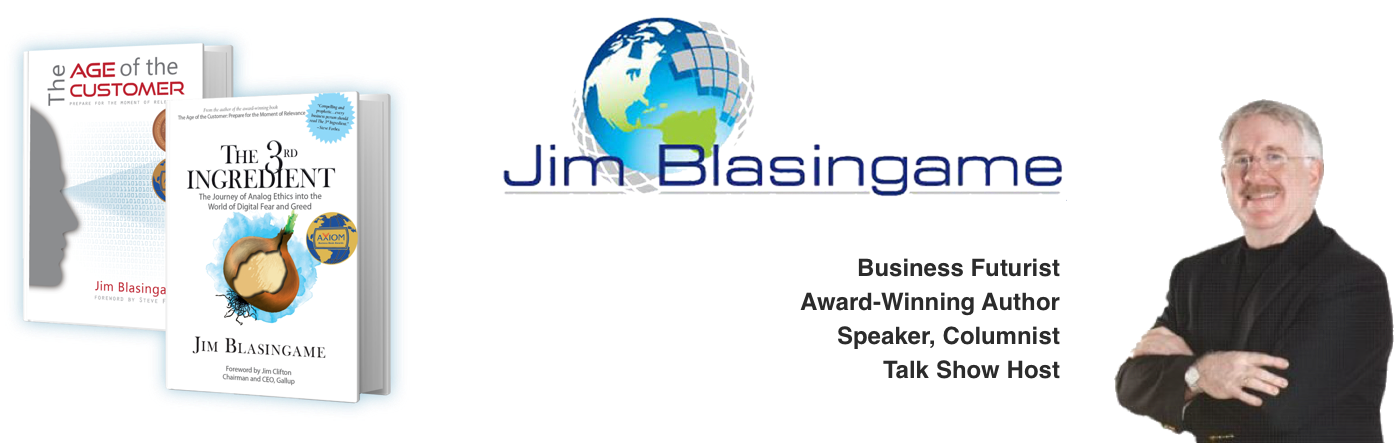
header image
  • Home
  • Books
    • The Third Ingredient
    • Age of the Customer
  • Speaking
  • About Jim
  • Press Room
    • Jim In the News
    • Press Materials
  • Blog
  • Contact
Buy Now
  • Facebook
  • LinkedIn
  • Twitter
  • Home
  • Books
    • The Third Ingredient
    • Age of the Customer
  • Speaking
  • About Jim
  • Press Room
    • Jim In the News
    • Press Materials
  • Blog
  • Contact

Blog

America Celebrates Its First SemiQ

July 3, 2026 by Jim Blasingame

An essay by Jim Blasingame  ©2026

Eight score and three years ago, in his inspired speech at the 1863 dedication of the Gettysburg Cemetery, President Lincoln delivered these immortal words: “…our fathers brought forth on this continent, a new nation, conceived in liberty and dedicated to the proposition that all men are created equal.”

Four score and seven years earlier, one of those “fathers,” an inspired Thomas Jefferson authored what is arguably the most momentous secular document in history. With suggestions from a no less able editor than Ben Franklin, the second paragraph of America’s Declaration of Independence begins with this passionate passage:

“We hold these truths to be self-evident, that all men are created equal, that they are endowed by their Creator with certain unalienable rights that, among these are Life, Liberty, and the pursuit of Happiness.”

At that moment, when monarchy was the universal model of government, it was unprecedented for “the colonies” to declare independence and claim sovereignty. And then, in the process of defending those “rights” from within and without for the next two-and-a-half centuries, America became legendary.

Right now, in Heaven, King George III said, “Who knew?” To which Jefferson, Adams, Franklin, Jay, Madison, Hamilton and Washington responded, in unison: “We did, dummy.”

Eleven years after the Declaration, as the U.S. Constitution was being signed in 1787, Franklin was asked to define this new type of government. His now famous response was: “A republic, if you can keep it.”

And keep it we did. In fact, we’ve kept it so long that a brand new term had to be constructed from three Latin words to describe America’s current birthday: semiquincentennial (it means half of 500). Since you can’t say that three times real fast, let’s coin a contraction and make it a proper noun: “SemiQ.” You’re welcome.

To be sure, the land of the free and the home of the brave has had lapses in the delivery of some of Jefferson’s founding tenets. Perhaps no other sentiment better reveals America’s imperfect devotion to keeping these promises than this 1858 quote from U.S. Senate candidate Abraham Lincoln as he campaigned against slavery: “We proposed to give all a chance; and we expected the weak to grow stronger, the ignorant, wiser; and all better, and happier together. We made the experiment; and the fruit is before us.”

Lincoln knew that America’s experiment would always be a work in progress. And Franklin would tell us that seeking perfection is a fool’s errand. But this July 4th represents 250 years of unwavering devotion to our most perfect right: freedom of expression. In fact, it was so primal to the Founders that the first words of James Madison’s immortal First Amendment declares this promise: “Congress shall make no law … abridging freedom of speech …” 

Any questions!?

Today, two-thirds of a SemiQ later, surely the best word to describe Lincoln’s “fruit” is abundance. But beyond the physical, America has achieved longevity by cultivating and preserving ideas and values. That’s the beauty of intangibles, isn’t it? They can be preserved and flourish in hearts and minds – forever.

Abundance, thy name is America.

Almost a SemiQ before Lincoln, and barely a decade after the Mayflower contingent set foot at Plymouth landing, Governor John Winthrop spoke of his vision for America in a 1630 sermon to the Massachusetts Bay colony. He imagined it as a “shining city upon a hill.” And, warts and all, Winthrop’s vision became reality as the United States of America became a benefactor nation unlike any other in history. With billions of global beneficiaries having been inspired by America’s ideals and blessed by its generosity, surely that’s multifaceted abundance.

Today, all Americans – every one – can claim their own blessing of abundance. But then, if any fruit is found wanting, use that same claim to simultaneously be empowered to take a position in search of repair and reform. In fact, that last part ran so deep in the Founders that Madison installed it – subordinate only to church and expression – in the second half of the First Amendment: “Congress shall make no laws … abridging … the right of the people to peaceably assemble … and petition the government for a redress of grievances.” 

Go find that in China, or Russia, or Cuba, or Iran.

One of America’s great ironies of our devotion to the First Amendment is allowing protests and rhetorical attacks on American values and institutions by those who often simultaneously invoke a country, cause or ideology where such behavior is specifically forbidden.

It’s true that our national journey has been marked by many waypoints, with new things learned and old wrongs righted. Indeed, now two SemiQs since Plymouth, at once striving for growth and praying for redemption, we’ll surely discover more moments that challenge us. But here in the throes of this unique celebration, America strives mightily to sustain devotion to Jefferson’s “unalienable rights” – available to every citizen.

It must be noted that freedom isn’t an American franchise – it’s a blessing from God and is found around the world. But as Jefferson reasoned seven score and six years after Winthrop, freedom to pursue dreams, wherever they take us, is the very American ideal for which the Founders coined a powerful new word: liberty. As the fruit of freedom, liberty is a contract we give to each other every day as we pledge devotion to the secular scripture from whence we claim that promise: the immortal Constitution of the United States.

Thank you, Founders.

The value of Lincoln’s fruit and measure of its abundance is made manifest in the American marketplace. It was formed and has flourished like no other for one reason: American liberty. And along the way, liberty and opportunity merged to forge a uniquely American alloy: entrepreneurship. Entrepreneurship is the energy that has powered the American Dream at home, while simultaneously becoming our most productive export.

And we know that the fruit of American entrepreneurial energy is a force-multiplier that transcends business, as observed by two legendary economists: Scotland’s Adam Smith’s “invisible hand” theory holds that by merely pursuing our own self-interests we simultaneously benefit society – even if we didn’t intend it, (“The Wealth of Nations,” 1776). And France’s Frederick Bastiat proposed that “when goods cross borders, armies don’t,” (“Economic Sophisms,” 1847).

It’s self-evident that life, liberty, and the pursuit of happiness have been essential to millions of American entrepreneurs. And even when not intending it, twenty generations of builders and beneficiaries of the American Dream became faithful stewards of it for those who followed.

Thank you, small business owners.

Finally, perhaps more than any other time since Gettysburg, as we celebrate this landmark year, and claim liberty with equal measures of passion and compassion, let’s pledge to each other a renewed devotion to the spirit of Lincoln’s beautiful prayer as he closed his first Inaugural Address. That the relationships we forge with each other shall be “touched by the better angels of our nature.”

Now let’s all pray that history records our generation worthy of the awesome shoulders upon which we stand and that we become even better stewards of liberty into the next semiquincentennial. Amen.

Write this on a rock …

America’s fruit is before us – in abundance. Happy SemiQ.

_______________________

Jim Blasingame is one of the foremost thought-leaders on Main Street business and entrepreneurship, and author of the award-winning books, “The 3rd Ingredient” and “The Age of the Customer.”  jim@jbsba.com   ©2026

Filed Under: Entrepreneurship, Ethics / Trust, Global affairs, Government / Politics, Innovation / Creativity, Legal, Management Fundamentals, National and Global Economy, Start Ups, Trade: Import, Export, Globalization Tagged With: 1776+, Adams, America, Declaration of Independence, Founders, Franklin, Hamilton, Independence, Independence Day, Jay, Jefferson, July 4th, Lincoln, Madison, semiquincentennial, U.S. Constitution, Washington

The Parental Paradox: Why a father’s tough love is the harder job.

June 21, 2026 by Jim Blasingame

Here’s a warning no child has ever heard from a father: “You just wait ’til your mother gets home!”

By Jim Blasingame

Parental love is a paradox, simultaneously delivering the expectation of safe harbor with the obligation and consequences of discipline. As the father of an adult daughter and son, plus the grandfather of four knucklehead boys (Hurricane, Tornado, Crash and Trainwreck), I’ve learned some things about this paradox. 

All the hours logged as Dad and Poppy have often caused me to contemplate how different are the roles of mother and father, particularly and especially in the overt demonstration of parental love. And it’s fascinating how the manifestation of this love differs between mother and father – biologically, psychologically, emotionally and experientially. 

Maternal love, at once gentle and fierce, is observed in almost all animals, not just humans. No doubt you’ve heard this simile: “… as sweet as a mother’s love.” And this warning: “Never get between a mama bear and her cub.” I’ve witnessed and have been the happy recipient of the “mama” side of the parental paradox, and there truly is no other force in nature like it.

However, a human father’s love is more often associated with the discipline half of the paradox by unfortunate references like “tough” and “strict.” Here’s a warning no child has ever heard from a father: “Well, you just wait ’til your mother gets home!” As a teenager, after years of receiving innumerable applications of his tough love, my dad once – and only once – apologized “if” his approach to delivering paternal love might seem “hard-boiled.” It did. But, recognizing that this extremely rare gesture was also rhetorical, I chose discretion as the better part of valor and my rights under Miranda to remain silent.

Clearly, mothers occupy the pinnacle of parental love – with complete justification. And not to take anything away from it, but a mother’s sweet love is as primal as the miracle of birth. Indeed, it’s their first nature. So, let’s be honest, they don’t have to work too hard to deliver it.

Alas, it’s troubling that there are no corresponding sweet references to paternal love. Could this be why Father’s Day isn’t quite as big a deal as Mother’s Day? I’m just sayin’ …

So, on this Father’s Day, let’s resolve that human paternal love deserves a better rap for at least three unique reasons:

  • A human father’s tough love is more learned than primal and does not exist outside of homo sapiens.  
  • When a father’s toughness is delivered, especially when applied to an indignant recipient (read: teenager), it requires a love that is at once courageous and patient. Courageous enough to endure negative responses, and patient enough to defer gratification for having dispensed that lesson. Sometimes for years. Maybe decades.
  • It isn’t fair that a grandfather can be adjudged “wa-ay cooler” than a father. (Until you are one.)

It must be said that no one is more keenly aware of the distinction between the application of the two kinds of parental love than a single parent (especially single moms). Particularly, when sweet and tough must be delivered by the same person, perhaps within minutes. God bless them every one.

My own Dad has been gone 22 years. But what I’ve discovered since is that he never really left me. He’s right beside me every time I pick up a tool, or figure something out (without YouTube or AI), or do a good deed, or take responsibility, or … you get the picture. BTW, his name was James and he helped save the world with General Patton during WWII. I never heard him make an excuse or call in sick. And he showed me how to be man and taught me the nobility of work even when such lessons were not cool.

Finally, mothers, please forgive any bias you may detect, but here’s my conclusion about the paradox of parental love: The only force in the universe that comes close to a mother’s sweet/fierce love is a father’s tough/courageous love. But the latter is the harder job, and the return on investment almost always takes longer.

Write this on a rock …

Happy Father’s Day, Dads. You’ve earned it.

________________________________
JIM BLASINGAME is a leading thought-leader on Main Street business and entrepreneurship. He’s an award-winning author, and was podcasting a decade before most people heard of it. jim@jbsba.com

Filed Under: Entrepreneurship, Work-Life / Balance Tagged With: family dynamics, father's day, leadership, parenting, Priorities, small business, small business owner, success, work-life balance

The Third Law of Stupid

May 31, 2026 by Jim Blasingame

By Jim Blasingame ©2026

In his excellent little gem, “The Basic Laws of Human Stupidity,” author Carlo M. Cipolla crystalizes the impact stupid people have on the rest of us. You know. When we aren’t being one of those people.

Cipolla breaks human behavior into four quadrants and establishes five laws with which to identify and manage others when they exhibit stupidity in our presence. Of course, I encourage you to buy Cipolla’s book and avail yourself of all his wisdom. But for our purpose here, we’re only going to deal with Cipolla’s cardinal behavior found in his Third Law:

“A stupid person is someone who causes losses to another person, or group of persons, while himself deriving no gain, and possibly incurring losses.”

Take a sec and think about that behavior and people you know who this law describes. I’ll wait here. Hmm … hmm … hmm …

We’ve all known stupid people but have probably miscategorized them. When someone opposes us on a matter about which we’re very serious, if not passionate, well, then, we’re likely to minimize their position by declaring it – and them – to be stupid. But Cipolla would challenge us.

During that discussion/argument/negotiation, our antagonist likely holds the opposing view because he anticipates some level of positive outcome for himself if he prevails. Cipolla says we shouldn’t regard such self-interest behavior as stupid. In fact, he holds that it’s quite logical and perfectly human. This will be on the test: Stupid people cause harm when their behavior benefits no one – including themselves.

Now that we’re properly oriented, let’s see where we can find stupid in our world today. 

When “stupid politics” is redundant

Whoa! That didn’t take long.

You may not be surprised that the immediate result of our search for stupidity lands us in the middle of contemporary U.S. political debate. Someone once allowed that “the Democrat Party is the evil party, and the Republican Party is the stupid party.”

History is replete with examples of political debate getting out of hand. Ask Julius Ceasar.  Or Alexander Hamilton. But, thankfully, historically, most political debates have ended in a very non-stupid state – a compromise. Cipolla calls that behavior “intelligent.” It’s the opposite of stupid, because everyone gets something they can live with. And you’ll recognize a fully executed, hard-fought intelligent transaction when you see it, because both sides will have a tear in their eyes. 

Alas, the wages of the stupid – harm – seem to increasingly prevail over the fruit of compromise – progress. And today, this imbalance lives prominently at the geopolitical level of the national debate.

The Vandenberg Resolution
Once upon a time, in a galaxy far, far away, a maxim was coined by one of America’s bipartisan champions, Senator Arthur Vandenberg, (R-MI). Post WWII, the Senator proposed that in matters of national security, international relations and geopolitics, Congress should defer to the Executive. The Commander-in-Chief should be given the benefit of the doubt and not weakened abroad by internal political differences. And for several decades thereafter, with rare exceptions, American political differences stopped “at waters’ edge.”

The power of this practice was both simple and sensible, based on two immutables: 1) countries don’t have friends, they have interests; and 2) the United States of America, warts and all, the only benign superpower on Earth, is outnumbered by the malevolent states.  

Therefore, as galling as it may be for the rotating “loyal opposition” to accept, to violate Vandenberg would be like rooting for the opposing team.  Who does that?

When stupid shifted a paradigm
Unfortunately, as my late friend and revered futurist Joel Barker taught us, the paradigm has shifted.

As an Earthling, if you value life, liberty and humanity, irrespective of political philosophy, the multi-layered Iranian regime is a threat to all you hold dear. As dastardly as other “nuclear” countries may be, for over 80 years, the world has been spared a nuclear event thanks to a concept Cipolla would classify as intelligent: MAD – Mutually Assured Destruction.  So-armed nations have recognized that unleashing a nuclear attack would almost certainly result in a lose-lose scenario, which would be contrary to their fundamental negotiating goals – to win AND survive.

Up to now, employing any kind of nuclear weapon has been recognized as the essence of Cipolla’s Third Law: stupid behavior that could define existential.

So, with all the monomaniacal behavior of the Iranian regime – now several layers deeper than previously thought – in what Bizarro World is managing this global threat not the perfect application of Vandenberg’s Resolution? Even if you’re not compelled to help, at least don’t hurt.

Only the stupid would lend leverage to an entrenched belief system that defines success as not merely the conquering, but the annihilation of an entire populace, including their diaspora. Plus, that singular benign superpower and it’s 342 million citizens. Even if it kills you and every Iranian citizen.

If you viscerally denounce a president’s social media posts; when you attempt some political advantage from a policy you think is “wrong for America;” even if you hypocritically rail against the appropriation of a practice your side of the aisle invented and used for decades,  I’ll defend to the death your right to take those positions. Because inside our “waters’ edge,” where “politics ain’t beanbag,” there can always be hope that our passionate positions will set us on a coarse to compromise.

But, outside of the CCP and Politburo, who supports the Iranian regime’s prime goal of unfettered possession of nuclear material and technology?  As it turns out, apparently, some who personify Cipolla’s Third Law.

Ut prius – the most dangerous stupid

In 2006, Italian Prime Minister Silvio Berlusconi loved us up by declaring his county’s feelings toward America were both post hoc and ut prius, “We love everything Americans do. We even love what they do before they do it.”  

It’s your right – and not stupid at all – to passionately protest something I do or say, including if I forecast my intentions. But what do we call it when advanced opposition is assured ut prius – before it exists or even proposed?  Before being appraised for value. Before it’s known who, if anyone, will benefit or be harmed.

Since such behavior is so patently illogical, it qualifies under Cipolla’s Third Law: it’s stupid.

When an obvious quest for political gain results in condemnation of everything a president does, including violating Vandenberg, while that administration attempts to defuse a murderous regime’s single-minded devotion to acquiring nuclear weapons, you’ve crossed the Rubicon between a tear in everyone’s eye to everyone losing. You’ve telegraphed your opposition – ut prius.

And that, according to Cipolla, is stupid.

Today, sadly, political stupidity is manifesting as a kind of viral derangement syndrome fueled by no less than hate. The last half of the definition of hate provides this judgment: it can have a destructive effect on the individual and communities.

If the Iranian regime is motivated by hatred of Israel and America, how does more hate contribute to a resolution? Wouldn’t that be stupid?

Going forward, whenever we observe anyone seeking political gain when such behavior could actually cause harm to everyone, we can thank Cipolla for providing us with a precise and handy label.

Let’s call it, “Cipolla’s First Law of Politics: Don’t be stupid.”

__________________________________
Jim Blasingame is one of the world’s foremost thought-leaders on entrepreneurship and the Main Street economy.

Filed Under: Ethics / Trust, Global affairs, Government / Politics, Leadership, Management Fundamentals, National and Global Economy, Negotiating, Trade: Import, Export, Globalization Tagged With: Berlusconi, Bizarro, Carlo Cipolla, CCP, Congress, Democratic Party, GOP, Iran, IRGC, Israel, MAD, Middle East, Mutually Assured Destruction, Nuclear, Paradigm, Politburo, politics, Republican Party, Strait of Hormuz, TDS, Trump, Ut prius, Vandenberg

Spring Cleaning For Small Business? Yes! In December!

December 12, 2023 by Jim Blasingame

Whether it’s a year where something we once knew as “normal” was part of our reality, or during an unprecedented and unimaginable year of a global pandemic, the abiding management question for all small business owners is always valid: “What’s the best use of my time right now?” And at no other time of the year are we more time-management challenged than in December.

The twelfth calendar month is the only one where two powerful imperatives converge against a hard stop, each demanding a full measure of your time, attention, and resources:

  1. The perennial push to close out the sales year as strongly as possible, while
  2. Simultaneously taking steps to set the business up for a fast and clean start when the New Year dawns on January 1.

Pardon the football metaphor, but in the marketplace game, your business plays all year, December is the two-minute drill of your fourth quarter. And in this tight transition period, that fierce competition for precious time and resources requires discipline and devotion to fundamentals.

Our grandmothers practiced the fundamentals of spring cleaning when the weather broke warm. In the marketplace, in order to kick off the New Year right, your spring cleaning should happen before then. There are many targets for a business’s December cleaning, but here are five important ones to get you started.[Continue Reading]

Filed Under: Cash Flow, Customer Care, Entrepreneurship, Finance / Accounting / Taxes, Human Resources, Management Fundamentals, Profitability, Sales / Sales Management Tagged With: management fundamentals, small business, small business owner, success

When Cause And Effect Converged With Humanity

November 21, 2023 by Jim Blasingame

Editor’s Note: Jim wrote the origins of this article and published it in Volume I, Issue 2 of his NEWSLETTER, November 21, 1999. 

This is a story about how cause and effect merged parallel universes and one person made a difference that changed the course of human history.

As the 17th Century dawned on the New World, a manchild was born to the Patuxet tribe. His father named him Tisquantum. They were part of a confederation of tribes known as the Wampanoag (“eastern people”), inhabiting much of what became known as New England.

In time, Tisquantum would become a very important individual to the future of America, but not before his life would change in ways not to be imagined by any 17th-century Earthling. [Continue Reading]

Filed Under: Ethics / Trust, Leadership, Miscellaneous, Work-Life / Balance Tagged With: ethics, leadership, Pilgrims, Samoset, serendipity, Squanto, Thanksgiving

Veteran’s Day: Recognizing And Honoring All Who Served

November 11, 2023 by Jim Blasingame

Veterans Day in America has its origins in Armistice Day. 

“To us in America, the reflections of Armistice Day will be filled with solemn pride in the heroism of those who died in the country’s service and with gratitude for the victory.”

That 1919 quote by President Wilson commemorated the first anniversary of the signing of the Treaty of Versailles, which ended WWI “in the eleventh hour of the eleventh day of the eleventh month.” And then, on November 11, 1938, Congress made “Armistice Day” a federal holiday.

But since that war did not, in fact, end all wars, a decade later, an Emporia, Kansas small business owner named Alvin King had a problem with the narrowness of the Armistice Day definition. It turns out that Al’s nephew, John E. Cooper, was killed in the Battle of the Bulge in WWII, which motivated him and the Emporia Chamber of Commerce to start a movement to redefine Armistice Day and give it a new name: [Continue Reading]

Filed Under: Entrepreneurship, Government / Politics, Leadership, Miscellaneous, Work-Life / Balance Tagged With: America, Armistice Day, entrepreneurship, leadership, small business owner, veterans, veterans day, work-life balance

  • Page 1
  • Page 2
  • Page 3
  • …
  • Page 52
  • Next Page »

Categories

  • Banking
  • Business Planning
  • Buying a Business
  • Cash Flow
  • Communication
  • Coronavirus
  • Corporate Culture
  • Customer Care
  • Cybersecurity
  • Demographics, Generations
  • e-business
  • Entrepreneurship
  • Ethics / Trust
  • Finance / Accounting / Taxes
  • Franchising / Licensing
  • Futuring
  • Global affairs
  • Government / Politics
  • Human Resources
  • Innovation / Creativity
  • Intellectual Property
  • Investors
  • Leadership
  • Legal
  • Management Fundamentals
  • Marketing / Branding / Advertising
  • Miscellaneous
  • Mobile Computing
  • National and Global Economy
  • Negotiating
  • Networking
  • Profitability
  • Sales / Sales Management
  • Social Media
  • Start Ups
  • Technology – Blockchain
  • Technology / General
  • The 3rd Ingredient
  • The Age of the Customer
  • Trade: Import, Export, Globalization
  • Trade: Import, Export, Globalization
  • Uncategorized
  • Work-Life / Balance

Archives

  • July 2026
  • June 2026
  • May 2026
  • December 2023
  • November 2023
  • October 2023
  • September 2023
  • August 2023
  • July 2023
  • June 2023
  • April 2023
  • March 2023
  • February 2023
  • January 2023
  • December 2022
  • November 2022
  • October 2022
  • September 2022
  • August 2022
  • July 2022
  • June 2022
  • May 2022
  • April 2022
  • March 2022
  • February 2022
  • January 2022
  • December 2021
  • November 2021
  • October 2021
  • September 2021
  • August 2021
  • July 2021
  • June 2021
  • May 2021
  • April 2021
  • March 2021
  • February 2021
  • January 2021
  • December 2020
  • November 2020
  • October 2020
  • September 2020
  • August 2020
  • July 2020
  • June 2020
  • May 2020
  • April 2020
  • March 2020
  • February 2020
  • January 2020
  • December 2019
  • November 2019
  • October 2019
  • September 2019
  • August 2019
  • July 2019
  • June 2019
  • May 2019
  • April 2019
  • March 2019
  • February 2019
  • January 2019
  • December 2018
  • November 2018
  • October 2018
  • September 2018
  • August 2018
  • July 2018
  • June 2018
  • May 2018
  • April 2018
  • March 2018
  • February 2018
  • January 2018
  • December 2017
  • November 2017
  • October 2017

Share this page with your friends and followers

© 2026 · Jim BlasingameContact Us